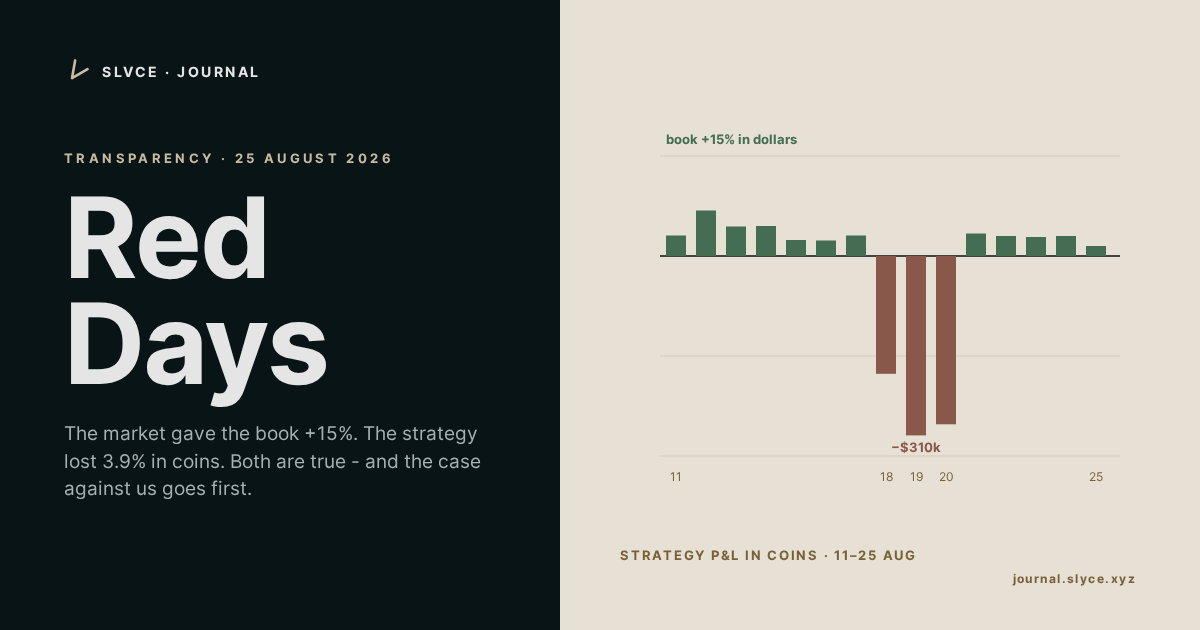
Between 18 and 22 August, SOL went from $77 to $102, Bitcoin from $65,000 to $79,000, Ether from $1,900 to $2,500. The dollar value of the SLVCE Core book rose about 15% in the same window.
Inside that window, the strategy - the part of the book we are actually paid for - had its three worst days since inception. In coins, the ledger says −$78,500 on the 18th, −$119,600 on the 19th, −$112,200 on the 20th. About $310,000 in three sessions. Roughly 3.9% of the book, measured the way we measure ourselves.
If you only read the headline, you saw a fund that made money in a rally. If you only read the strategy line, you saw a fund that lost money in a rally. The purpose of this piece is not to pick one. It is to show you both, explain how they coexist, and then do the thing most of these letters do not do: make the strongest case against us we can construct, and answer it point by point.
We publish red days in red. Here is why that is not a slogan.
What happened, in the order it happened
The first week is the one we like: a quiet market, the engine collecting fees, the strategy line adding $10,000-$30,000 a day. Boring is the business.
Then the market gapped. Not drifted - gapped. Prices moved further in a session than the engine's quotes are designed to be wrong by. That is the defining condition for a market-maker's bad day, and it deserves one paragraph of mechanics.
A market-making book earns a spread for standing ready to take the other side. It is profitable against people who trade for their own reasons - rebalancing, taking profit, getting paid, getting bored. It is expensive against people who know the price has moved before your quotes do - they lift your offer in the moments before your quote agrees with the market. The trade has a name, adverse selection, and it has one signature: the more one-directional the tape, the more of your fills are the wrong side of the move. Fees keep arriving. They do not keep up.
On the 21st the tape normalised and the strategy went back to doing what it does. By the 22nd the dollar curve printed its first red day of the rally - not because the strategy lost, but because Ether gave back half a percent and the book is marked in dollars. That day is red on the public curve. The 19th and 20th, the strategy's two worst days on record, are not. Sit with that for a moment, because it is where most of the confusion about this fortnight lives.
Two lenses, two truths
We keep one ledger and two lenses on it, and we are unusually insistent that you look at both.
The dollar lens is the one everyone understands: what is the book worth today, in dollars, if we marked every coin at the current price. On this lens the fortnight is +15%, and only five of the fifteen days are red - all of them price days, none of them strategy days.
The coin lens is how we judge the strategy: how many coins did it add or lose, independent of what the coins were worth. Fees are charged on the dollar lens - that is what the documents say and what the statement shows. The coin lens is not a fee base; it is the measure of the strategy's own contribution, separated from the market's. On this lens the fortnight has three deep red days and twelve ordinary green ones, and the net of the fortnight is negative - about $180,000 of fee income across the twelve quiet days against $310,000 lost in the three loud ones.
Neither lens is wrong. They answer different questions. The dollar lens is the investor's outcome. The coin lens is the strategy's contribution - what the people running the book added or subtracted, separately from the tide they are floating on.
The reason we split the two on every statement, every push notification and every public page is that a rally is the single easiest environment in which to hide a bad strategy. Nobody audits the rowing when the tide is coming in. If we let a +25% move in SOL enter the strategy column, we would look brilliant for a fortnight and you would have no way of knowing we had just lost 3.9% of your coins.
So: the book made money, the strategy lost money, and the second sentence is the one we think you should read twice.
The case against us
Now the part we owe you. If a sceptical allocator sat with our numbers for an afternoon, these are the five things they would put to us. We have tried to write them the way they would, not the way we would prefer.
1. "A 3.9% loss in three days is not a market-maker's bad week. It is a market-maker without a brake."
This is the strongest of the five and it is mostly right.
The engine has adverse-selection controls: it widens when flow turns one-directional, it pulls quotes when volatility quality falls, it holds an increasing share of the book in stablecoin as drawdown deepens. In June, in a selloff, those controls did their job - we wrote about it at the time. In August, in a rally, they engaged late. The tape did not look toxic on the signals the controls read; it looked like a healthy market going up. Flow toxicity stayed in the normal band while price ran away from the quotes. The controls are tuned for stress, and a gap-up in a clean market is not stress. It is just expensive.
Where the critic is right: three consecutive days of the same failure mode is not one bad day, it is a control that did not learn on day one. Where the critic is not quite right: the loss is bounded by design. No leverage, no directional position, a stablecoin buffer that was already rising by the 20th. The strategy ended the three days with fewer coins. It did not suffer a liquidation, create a liability, or impair the book's ability to keep operating. A −3.9% week for a business that runs no leverage is a bad week; it is not a structural event.
Our first instinct was a control change: read price displacement against the quote as a first-class trigger, so that a clean tape outrunning the quotes is treated as the same emergency as a dirty one. Before writing that into the engine we replayed it. The replay is below, and it did not say what we expected.
2. "Your small accounts show losses of 300 to 1,000 basis points on their market-making turnover. That is not a strategy, that is noise you are charging fees on."
Also fair, and it exposes something we had been under-explaining.
Adverse-selection losses do not scale proportionally with the size of the book: a wrong-side fill costs what it costs, and the smallest accounts take fills of a size that is not much smaller than the largest ones take. Fee income, by contrast, scales with turnover, and turnover scales with the book. The observed result is that the same three-day gap cost the largest accounts about 80-130 basis points of their market-making turnover and the smallest ones 600-1,000. We state this as what the ledger shows, not as a law; the mechanism - order sizing, fill counts and inventory limits on small books - is something we are still measuring rather than asserting. The lines are correct, the disparity is real, and it means the small-account experience of a red day is genuinely worse than the headline suggests.
We already lead small-account reporting with absolute coin numbers rather than percentages for a related reason - percentages on a $10,000 book exaggerate everything in both directions. The honest addition, which we are making, is a line on every small-account statement saying exactly this: your bad days may be proportionally larger than the fund's; our observed small-account results show that asymmetry, and we are measuring exactly why.
3. "You sold your investors downside protection and it burned to nothing in a rally. Either the hedge was wrong or it was theatre."
Neither, but the critic is entitled to the question.
The hedge program holds put protection on the book's coin exposure. In a rally, puts expire worthless - that is the whole point of a put: you pay a premium so that a bad month has a floor, and in a good month the premium is gone. The pool's value per unit fell by roughly nine-tenths across the rally. The August settlement will land on the accounts on the first of the month, and it will be visible on the public log like everything else.
The uncomfortable part is not that the hedge lost. It is that the hedge lost in the same window the strategy lost. Protection against a crash did nothing against a gap-up, and the strategy's bad days were gap-ups. That is not a defect of the put; it is a limit of it. A put protects the value of your coins. Nothing we hold protects the strategy's earnings against adverse selection, and we should not have let anyone assume otherwise. The offering documents say this. The marketing did not say it loudly enough. This paragraph is us saying it loudly.
4. "Your fee line went up on the worst days. That looks like a number being made up."
It went up because the engine's fee line is turnover times capture, and turnover explodes in a gap. More prints, more claims, more fees - at the same time as more wrong-side fills. That is the normal anatomy of a bad day for a maker: gross fees rise, net result falls. What matters for a reader is that the two lines are shown separately and that the net is the one on the headline. It is.
We will add one thing the critic is right to want: a per-day table of gross fees and gross adverse fills on the public curve, so that "fees up, net down" can be read directly rather than inferred.
5. "You publish a hash-chained attestation of your NAV and you had to correct thirty-four days of it. How is that different from restating?"
This is the one we least enjoyed writing, and the one we most want in print.
On 25 August we found that the daily attestation - the timestamped, hash-chained record of the book's dollar value that we publish so nobody has to take our word for it - had, on 34 of 169 days, recorded a mid-day snapshot instead of the day's final one. The cause was mundane: the process that writes the attestation read from a cache that served the previous build, and on some days that build was hours old. The drift ran in both directions - twenty days too low, fourteen too high - with no net bias. Nobody gained from it. It was simply wrong.
Here is the difference from a restatement. Not one of the 34 records was edited. The chain is append-only by construction; you cannot rewrite a past entry without breaking every hash after it. What we did instead was append 34 correction records, each naming the exact entry it supersedes, each hashed into the chain after everything that came before, and each anchored into Bitcoin with the rest of the head. The wrong numbers are still there, still verifiable, still timestamped. Next to each one is the right number, also timestamped, and a note saying which is which. You can run the public verifier yourself; it reports 203 records, 169 days, 34 errata, and a valid chain.
That is the whole philosophy in one incident. We did not fix the record by making the mistake disappear. We fixed it by making the mistake permanent and putting the correction beside it.
The case for us
Having let the prosecution speak, three points in our defence. Not rebuttals - the criticisms above mostly stand - but the reasons we think the fortnight, read whole, is evidence for the model rather than against it.
First: you knew. Not from this piece. From the ledger, on the day. The strategy line on your statement was red on the 18th, the 19th and the 20th, in coins, while the dollar line was green. The app pushed you the split every morning. There was no window in which the rally was being presented as skill. A reporting model that forces market beta and strategy contribution into separate columns makes one of the easiest forms of performance embellishment much harder: letting a rising asset masquerade as manager skill. The only way to demonstrate that the columns really are separate is to have a bad week in a good market and show you the two lines diverging. This was that week.
Second: the loss was the loss. No leverage, no directional bet, no drawdown on borrowed money, no gating, no notice period invoked. The book ended the fortnight with more dollars and slightly fewer coins, and every one of those coins is still on the venues where it works. A red day in this structure is a bad payday, not a hole.
Third: the corrections are the product. The errata on the attestation, the control changes on adverse selection, the small-account disclosure - none of it was demanded by an investor. It came out of an internal review that we run precisely because we expect to find things. A fund that never publishes a correction has either never made a mistake or never looked. We look, hourly, with a check that is designed to flag our own tape before an outsider does. It flagged this fortnight. This piece is the result.
Would the proposed fix have worked?
The allocator's question, after all of the above, is the only one that matters: how much of the $310,000 would the fix have prevented? An engineering answer ("we changed the control") is not evidence. A replay is closer to it, so we ran one.
We keep a shadow market-maker that quotes against the real Binance tape - every print, no synthetic flow - and records, for each fill, the capture at the quote and the market's move five minutes later. It is the instrument behind the Liquidity Weather toxicity signal, and it is the only honest replay we have: real prices, real fills, no look-ahead. For 18-20 August it holds just over a million fills across SOL, BTC and ETH.
We applied the proposed control to that tape: if the mid had moved more than a threshold over a trailing window, the quotes are pulled and the fills in that window do not happen. Twelve variants - windows from one minute to one hour, thresholds from 0.2% to 0.8%.
Three things came out of it, none of them the thing we had planned to write.
The displacement control would have made it worse. In every variant, the fills the rule removes carried positive expected value; the adverse ones happened before the mid had visibly moved, which is what adverse selection means. Pulling on displacement is pulling after the horse has left. We are not shipping it.
The rule that "works" is not a strategy. Gating on one-sided flow - stop quoting when nine of the last ten fills hit the same side - brings the shadow book back to break-even over the three days. It does so by refusing to quote for 55-80% of the time. A market-maker that is absent whenever the market is moving is a market-maker that collects fees only in the weather where fees are smallest. We will test narrower versions of it; we will not sell it as a fix.
The replay could not reproduce the loss. This is the finding. Over the same three days the shadow book, quoting the CEX tape, lost about $4,100 on $141 million of turnover - a third of a basis point. The live strategy lost $310,000. The live book does not quote a CEX order book; it holds inventory in on-chain liquidity positions, collects fees and rebalances, and its bad days come from the inventory side, not from quote placement. Our adverse-selection controls, and our replay, are built on the tape where the damage did not happen. That is the actual defect the fortnight exposed, and it is a larger one than a tuning parameter.
So the honest state of the record is: diagnosis, yes; a control change we can put a number on, not yet. The change we are making is to the instrument first - a shadow book for the on-chain inventory leg, so that the next replay measures the leg that lost - and to the control second, once it can be replayed against that leg.
The replay is not evidence that any fix works. The next comparable event is. We will publish that event's replay alongside its ledger, whatever it says.
What changes, concretely
Because a letter like this is only worth anything if the last section is specific:
- Adverse-selection controls: the displacement trigger we first proposed is withdrawn - its own replay rejected it. We are building the shadow book for the on-chain inventory leg, where the loss actually occurred, and will change the control only once a change can be replayed against that leg and the replay published.
- Small-account statements carry a standing line on the asymmetry between fee income and adverse fills, and continue to lead with absolute coin numbers.
- The public curve gains a daily gross-fees / gross-adverse-fills table, so "fees up, net down" can be read, not inferred.
- The attestation reads its inputs fresh, refuses to attest a day whose final snapshot has not landed, and halts - and pages us - on any drift it cannot explain. The 34 corrections are appended, named and anchored.
- The hedge disclosure states plainly what a put does and does not protect: the value of the coins, not the earnings of the strategy.
None of these make the next red day green. They make it legible - and, for the first time, measurable against a fix before the fix is claimed.
Closing
The market handed us a good fortnight. We did not earn most of it, and we say so.
In coins, the strategy had its three worst days on record and a rally hid them from anyone reading only the headline. We do not let the headline stand alone; that is the point of the second line.
Where the critics are right, they are right. Where we corrected the record, the correction sits next to the error, hashed and timestamped, so that it can never be presented as if the error had not happened.
A system is not credible because it has controls. It is credible when its own evidence is allowed to reject them.
Good investing starts with good accounting. Good accounting starts with admitting which column the money belongs in - and which days were red.