A log entry, not an explainer. One specific week, what the screens showed, and the one line we refuse to let the market blur.
The event
Between 24 and 31 August 2026, SOL rose from about $95 to $102, touching $106 midweek - call it +7% on the week. A good stretch for anyone simply holding the asset.
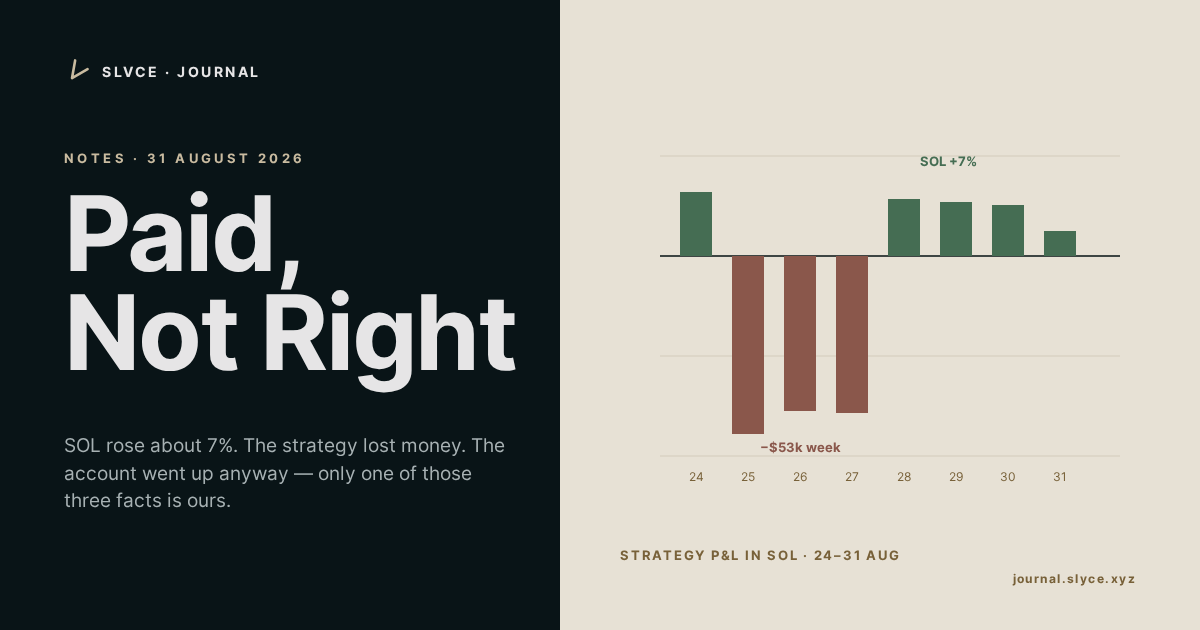
Over the exact same week, the engine that actually earns our return lost money. Not on a single bad afternoon - three consecutive red days, the 25th, 26th and 27th, before it steadied.
And next to that losing strategy, on every investor's screen, the account balance went up.
There is a comfortable way to read that - nice, we're up - and an honest one. We keep the log for the honest one.
What happened
Here is the return engine's daily P&L across those eight days, in SOL - the losing stretch in plain sight:
So the two numbers on the screen were pointing in opposite directions. The asset was up 7%. The strategy was down half a percent. And because much of the book remained economically exposed to SOL, a 7% rise in the asset outweighed a half-percent operating loss - so the dollar line went up anyway.
SOL rose about 7%.
The strategy lost money.
The account went up anyway.
Only one of those three facts is ours.
Why it happened
First, why the strategy lost. These three red days are not a new kind of event: they belong to the same inventory-side failure mode we named after 18-20 August - losses that come from the on-chain inventory leg, not from quote placement. We were honest in that post-mortem that the repair comes in two steps - build the instrument that can measure the leg that lost, then change the control - and that the instrument was not yet built. It still is not mature enough for us to claim a fix. Until it is, weeks like this one remain losses, not a solved problem - and we would rather show them to you than imply a repair we cannot yet measure.
And the account rose for a reason that has nothing to do with us being good this week: the thing it is measured in got more valuable. That is the market's gift, not our performance. We did not call the SOL move; we do not bet on the SOL move; we cannot take credit for the SOL move.
What is ours is the other number - the small operating loss - and we are not going to let the first one hide the second. A rising asset flatters everything it touches. It makes a losing week look like a winning one, a mediocre manager look sharp, and a directional bet look like a strategy. Most of the time, most places, nobody separates the two, because the combined line is green and green does not get questioned.
We separate them because the whole product is the separation. Yield is not alpha; a balance going up is not the same as a strategy that worked. This week is the mirror image of the June week when SOL fell 24% and the book was green every day - and it is the more honest of the two to publish, because it is the one where the market flattered us and we said so.
What the system did
Nothing heroic, and nothing hidden. The three red days were booked against the strategy, the SOL move against the market, and neither was smoothed into the other to make the week read cleaner. It reached your statement in exactly that split form - the market's line and the strategy's line kept apart - so a good week for SOL can never quietly pay for a bad week at the desk.
Why this matters
If a rising market can hide a losing week, it can hide a great deal - drift, leakage, even a strategy that has quietly stopped working. The entire reason to keep an honest ledger is so that the one number you can't feel - did the thing we actually do make money? - is always legible, especially in the weeks when the balance is green for reasons that owe us nothing.
A rising market can hide a losing week. Ours is not allowed to - that is the whole job.
So no, this was not a good week for the strategy. It was a fine week for your balance and a losing one for the engine, and you should be able to see both without squinting. The week the account went up while we lost money is not a week to quietly enjoy. It is the exact week the accounting earns its keep.
Notes are the fund's operating log - dated events, real numbers, published whether they flatter us or not. If you want the machinery underneath: Where Return Actually Comes From and How We Calculate NAV.