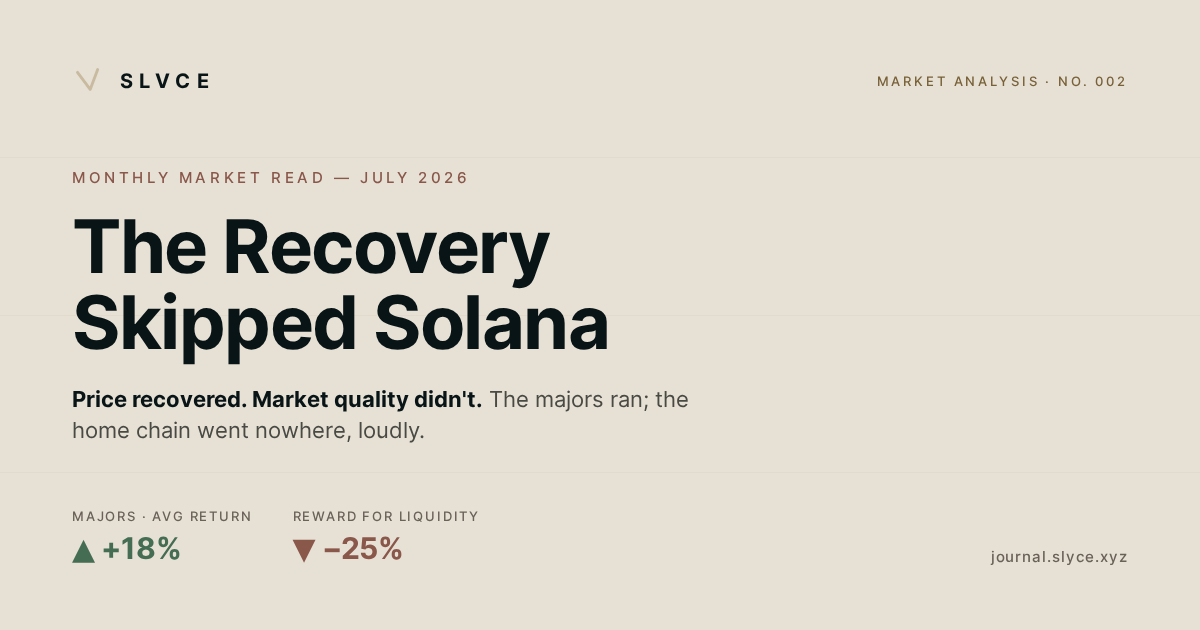
Price recovered. Market quality didn't.
That divergence is July.
Last month we said the plumbing healed before the price did - that market quality bottomed on June's crash day and recovered to its best of the quarter while SOL was still down 13%. July is the mirror image. The price came back. The market that pays us to stand in it quietly got worse. And the recovery, when it arrived, went everywhere except the chain we are named for.
This is the second monthly read. Same method as the first: we do not tell you what the market did - a dozen terminals do that better. We tell you what it looked like from inside the engine, layer by layer, with the telemetry no price chart can show. Including the part we would rather not headline.
One chart that explains the month
If you read nothing else, read this.
We will do one of these every month - a single image that carries the month's main idea, before the detail buries it. July's is the gap between those two bars.
The month in one breath
| Layer | July read | In a word |
|---|---|---|
| Price | SOL +4%; BTC +12%; ETH +24% | Divergent |
| Solana specifically | $74 → $84 → $77, a 16% range that netted +4% | Loud, still |
| Weather | Steady ~68/100 on the surface, thinning underneath | Softening |
| Fee environment | Sub-score fell 57 → 43 - the easy reward faded | Thinning |
| Toxicity / regime | AMBER 75% of the month by design, RED just 7% | Calm |
| Where return came from | Roughly even fee/spread split - pure liquidity, again | Neutral |
| The mix | BTC/ETH holdings caught a rally SOL missed | Earned its keep |
| The headwind | Our home chain lagged the majors by 5-6x | Real |
Three rows carry the whole story - Price, Weather, and the Mix. Prices rose, the quality of the market that hosts our return fell, and a holdings decision made long before July quietly caught the upside our home chain missed. Everything else is texture.
1 · The price layer
The majors recovered in near-straight lines. Ether led decisively, Bitcoin climbed steadily, and Solana - the asset our identity is built on - did the least while making the most noise about it.
But the average hides the more interesting fact. Solana was not quiet - it was busy going nowhere. It ran to $84 in the first week, gave it all back by mid-month, and ground back to $77 to close. The net move was +4%. The path traveled to get there spanned 16%.
Hold the distinction - net versus range - because it is the hinge the whole month turns on.
For a market-neutral book, SOL going nowhere loudly is one of the best markets you can be given. Spread is earned from movement, not from destination.
The price layer says Solana did nothing. The engine layer, two sections down, says Solana paid us to stand still.
2 · The market-quality layer
Here is where July inverts June. Last month, weather climbed as the market healed. This month, weather held steady on the surface and softened underneath - and the softening was concentrated in the one sub-score that most directly sets our return.
The headline weather number barely moved: 69.7 in week one, 67.9 in the last. A single number would tell you "conditions unchanged." That is exactly why we publish the decomposition - because underneath a flat total, the components pulled hard in opposite directions.
Regime confirms the calm. Our execution envelope - the guardrail that decides whether the fleet trades normally or retreats - sat in its steady-state AMBER band for three-quarters of the month, printed GREEN for 18%, and flashed RED for just 7%. RED is the "stand down" state; 7% is a benign month. There was no stress event to survive in July. There was only a slow erosion of how much the market was willing to pay us to be useful.
3 · The engine layer
3.1 · The chop dividend
Start with the counter-intuitive part, because the numbers only make sense once you accept it. Solana's 16% range against a 4% net move is the single most productive condition a spread engine can be handed - lots of movement to quote around, no persistent direction to be run over by. The price chart's most boring asset is the engine's most generous one.
So the prediction, before we look: in a month where the fee environment was actively deteriorating (Section 2), the spread leg should have held up anyway, propped by SOL's chop. If you take one non-obvious idea from this report, take that: for a market-neutral book, "SOL went nowhere" is a revenue line, not a disappointment.
3.2 · Where the return actually came from
Now the attribution - and it confirms exactly that.
The rebalancing engines are slightly negative (-31 SOL combined) and that is fine: in a month where holding the mix was the winning move, an engine whose job is to trim winners into stables will book small realized give-backs against a much larger unrealized gain. We would rather it under-trade a rally than churn one. When this attribution stops looking like liquidity provision, worry. It didn't.
3.3 · Capacity and infrastructure
No stress, nothing to report - which is itself the report. The book never approached its capacity ceiling; utilisation sat comfortably below the headroom line all month, with no venue squeeze and no forced size-down. Latency and rejection telemetry stayed in their normal bands. We note it plainly rather than dress a quiet month as a stress test passed.
4 · Diversification finally had a month to matter
This is the section June did not have, because June did not need it. In a month where the majors ran and the home chain stalled, the most important decision in the book was not an execution decision at all - it was a holdings decision made long before July started: the book is no longer SOL-only.
Bitcoin and Ether are held across the Core treasury and the Edge farming sleeves as working inventory, not as a directional call. In July that inventory did something a SOL-only book structurally could not: it captured a +12% and +24% move while SOL delivered +4%. The Edge book alone carried roughly $190K of realized farming yield on top of that price participation, its value sitting materially above deployed capital - the yield and the mix compounding in the same direction for once.
The honest framing matters here, and we hold to it: the market leg is not a strategy line. When BTC and ETH rise, the mix helps; when they fall, it will hurt, exactly as it did to SOL-heavy books in June. We do not get to claim the July upside as skill. What we can claim is the structural decision to stop betting the entire book on a single chain - and July was the month that decision quietly paid for itself.
5 · July in context
Two months into publishing this read, a pattern is worth stating out loud.
| Price | Market quality | The engine | |
|---|---|---|---|
| June | Down (a crash) | Up (it healed) | Same two liquidity legs |
| July | Up (a recovery) | Down (it thinned) | Same two liquidity legs |
Two months. Two opposite divergences. The engine behaved the same in both.
The constant across a violent month and a calm one is the source of return, not its size. That constancy is the entire product. The variable that is trending - and that we are watching - is the fee environment. It has now softened for a full month off its June-recovery high. One month is weather; a second consecutive month of thinning would be climate, and would show up as return that is harder to earn per unit of book. We will tell you if it does.
6 · What we learned
- Decompose or be misled. A flat weather total hid a collapse in the fee sub-score and a fall in volatility, nearly cancelled by firming depth. The single number would have told us nothing was happening. Something was.
- Range is a resource. SOL's noisy round-trip was the month's best market-making backdrop. We should size toward chop and stop reading low net moves as low opportunity.
- The mix is doing its job silently. The most valuable thing in the book this month was a holdings decision, not an execution one - and it is invisible on any single-asset chart.
7 · What surprised us
The fee environment softened faster than volatility did. We expected them to fade together as the recovery matured; instead the reward for providing liquidity fell in the first two weeks while realized volatility was still elevated. The market stopped paying up for makers before it actually calmed down.
We don't have an explanation yet. We are flagging it precisely because it does not fit, not because we can account for it.
8 · What this report could be wrong about
- The mix cuts both ways, and we only showed you one side. July was a month where holding BTC/ETH helped. A symmetric month where they fall will hurt the exact same book by the exact same mechanism. Do not read Section 4 as a claim that the mix only adds; read it as a claim that we stopped concentrating the risk. The risk is still there.
- The chop dividend has a ceiling. "SOL went nowhere loudly" was a gift this month. A month where SOL trends hard in one direction would flip that sign - the same movement becomes adverse selection instead of spread. We benefited from a specific shape of volatility, not from volatility as such.
- One month of a thinning fee environment is not a trend. We flagged it because it is directionally worth watching, not because two data points make a line. We may be pattern-matching noise.
- Attribution is measured in SOL. The engine legs are booked in SOL terms; a strengthening or weakening SOL re-prices the same effort in dollars. We report the native figure to stay honest about what the engine did versus what the currency did - but it means the SOL numbers and the dollar experience can diverge, and July's lagging SOL widened that gap.
Definitions
- Weather / total score - a 0-100 composite of market-making conditions (volatility, fee environment, depth, inventory risk, opportunity, toxicity). Higher is a more rewarding, less hazardous market to make in.
- Fee-environment sub-score - the component of weather that measures reward available per unit of risk. It is the sub-score most directly tied to what a liquidity book earns.
- Envelope regime (GREEN / AMBER / RED) - the guardrail state governing whether the fleet trades normally (GREEN/AMBER) or stands down (RED). AMBER is the designed steady state, not a warning.
- Spread capture / fee capture - the two liquidity-provision return sources. Spread is earned from quoting both sides; fees from resting orders that get filled. Neither is a directional position.
- The mix / market leg - the price change on non-SOL inventory (BTC, ETH) the book holds as working capital. It is disclosed as its own line and never folded into strategy return, because it carries market direction we did not create.