A thesis piece, not a forecast. About what crypto became, and the category error hiding inside the transformation.
Crypto did not fail to escape politics. It succeeded - long enough, and largely enough, to become worth politicising. That is a very different story from the one usually told, in which the state "captured" a technology that was meant to be free. Nothing was captured. An asset was simply allowed to grow until it crossed the threshold every consequential thing eventually crosses: the point at which power notices it, and arrives.
This essay is about that arrival, and then about a mistake it invites - one that costs allocators far more than any political opinion ever will. The mistake is to conclude that because crypto is now shaped by geopolitics, the way to profit from it is to read the geopolitics. We think that gets the entire problem backwards, and by the end we will have replaced it with a single sentence we are willing to run a business on.
The promise
The original pitch was independence. A currency with no capital city, no central bank, no minister who could be telephoned on a Sunday night. Money as a protocol rather than a policy - neutral by construction, indifferent to flags and borders. For a while the story held, because almost nobody who mattered was paying attention. An asset is apolitical mostly when it is small enough to ignore.
It is worth being precise about what was neutral, because a careless version of this claim invites an easy rebuttal. A Bitcoin node still does not check a passport. A settlement transaction on a public chain does not care who signed it or why. At the level of the protocol - the rules that decide whether a transaction is valid - the system remains genuinely, almost aggressively, indifferent. That part of the promise was real, and it is still real.
But there are two different things wearing the same word here.
The protocol can remain politically indifferent while the asset built on it becomes politically consequential.
These are not contradictions. A rail can be neutral in its rules and deeply political in its use, its ownership, its regulation and its access.
A railway that will carry any cargo is neutral in its rules. It is still an object of national strategy - who owns it, who is allowed to board it, which goods may cross which border on it. The mistake of the early years was to hear "the protocol does not judge you" and conclude "therefore the asset stands outside politics." The protocol's indifference was never a shield around the asset. It was a property of one layer, and the layers above it - custody, exchange, regulation, reserve, access - were always going to be exactly as political as anything else that moves value at scale. What changed over the last cycle is simply that those upper layers filled in.
The reversal
Look at what actually happened to the "stateless" asset, layer by layer.
Sanctions turned it into an instrument of statecraft in both directions at once. It became a rail that some parties reach for to move value around a blockade - and, simultaneously, a surveillance surface that others use to trace, attribute and freeze that same value. The transparency sold as a liberation from banks turned out to cut the other way: the same public ledger that removes the gatekeeper also creates a financial surface unusually amenable to retrospective tracing. A permanent, timestamped, globally replicated record is a strange foundation for evasion, and an excellent one for forensics. Firms now exist whose entire business is reading that surface for governments, and they are good at it.
The dollar did not retreat from crypto. It arrived through the front door. Much of crypto's transactional layer now settles through dollar-denominated stablecoins - private tokens that function, in practice, as a distribution channel for dollar exposure into places the physical dollar reaches only with friction. Read that plainly:
The system built to route around sovereign money became one of the most efficient distribution rails for sovereign money.
That is not an escape from monetary power. It is one of its most effective modern exports, running on infrastructure the issuing state did not have to build, maintain, or even fully sanction. Whatever the founders intended, one of the largest transactional uses of public crypto rails today extends the reach of exactly the currency the movement was often pitched against.
Mining became energy policy. Where you are permitted to convert electricity into hashes, at what price, under what grid conditions and with what tax treatment, is now a question ministries answer, not markets. Hashrate migrates on regulation the way capital migrates on interest rates. A "decentralised" security budget turns out to be geographically concentrated, and therefore politically addressable, wherever cheap power and permissive law happen to coincide - and both of those are policy variables.
Institutionalisation wired it into the system's weather. The arrival of spot ETFs did the one thing the founders would least have predicted: it plugged the "alternative" asset directly into the same interest-rate and regulatory climate that moves every other institutional book on earth. The asset built to be uncorrelated to the traditional system got underwritten by that system's largest asset managers, held in its custodians, and repriced by its macro calendar. Correlation, conveniently absent when the asset was small, has a way of reappearing the moment the same holders own everything.
And reserves made it a sovereign question. Once states, funds and treasuries begin holding an asset - or debating strategic reserves of it - its price stops being a market curiosity and becomes an input to national balance sheets. Sovereign digital money, meanwhile, arrived on its own track: the proliferation of central-bank digital currency projects is not simply a reaction to crypto - it has its own drivers, from declining cash to payments modernisation to monetary sovereignty - but it is evidence that digital monetary infrastructure itself has become a domain of sovereign policy, the terrain crypto now shares.
Crypto did not stay outside politics.
It grew large enough that politics came in.
The neutrality was never a property of the asset.
It was a property of being ignored.
None of this is a complaint, and none of it is a verdict on whether crypto is good or bad. It is the ordinary life cycle of anything that becomes valuable: it stops being a curiosity and starts being a lever, and levers get held by whoever is strong enough to reach them. The interesting question is not political. It is what an investor is supposed to do with an asset that has crossed this line.
The category error
Here is where the essay turns from history to investing, because the reversal creates a very seductive conclusion.
If crypto is now geopolitical - if its price visibly responds to sanctions, elections, rate decisions, reserve announcements - then surely the way to make money is to read the geopolitics. Understand the world correctly and the asset does the rest. This is the instinct behind almost every "thesis-driven" crypto fund: we understand the direction of history, therefore we understand the direction of the price.
We want to be careful here, because the lazy version of the counter-argument is also wrong. It is not true that geopolitics fails to move the price - it moves it violently. And it is not true that nobody can analyse macro. Serious macro desks earn real returns from anticipation, from positioning ahead of a reaction function, from relative value across assets, from the way options price a distribution of outcomes rather than a single guess. Some of them are genuinely skilled, and the skill is not fake. Pretending otherwise would be its own dishonesty.
The problem is narrower, and much harder to escape.
Geopolitics can be analysed. What is far harder to establish is a repeatable mapping from geopolitical analysis to tradeable direction, timing and sizing.
A correct view of the world is not the same object as a profitable trade. Between the two sit three brutal filters. Timing: discontinuities - wars, sanctions regimes, central-bank pivots - do not announce their date, and the market prices the surprise in seconds, not weeks. Sizing: being right about the event and wrong about magnitude is indistinguishable, on the statement, from being simply wrong. Reflexivity: the more consensus a "correct" macro view becomes, the more it is already in the price, so that the better your analysis, the more crowded the position it implies. A view can be excellent and still map to no repeatable edge, because everything true about it is discounted before you can act on it.
So the honest description of a "macro crypto" book is uncomfortable but not insulting: it is a directional position on world events, wearing the costume of analysis. It will feel brilliant in the years the guess lands and existential in the years it does not, and the investor will have no durable way to separate the skill from the coin flip that happened to fall their way. We have written before about why that ambiguity is the real enemy - a track record you cannot separate from luck is not a track record, it is a story with good years in it.
The disciplined posture, then, is not the arrogant claim that macro is unknowable. It is a governance rule:
An allocator should be deeply suspicious of any strategy whose repeatability depends on being consistently earlier, and more correct, than the market about statecraft.
Not because such edges never exist. Because they are the rarest and least durable edges in finance, and building a business on them means building a business on the thing hardest to prove you have.
What politics actually changes
There is a quieter reading of the same facts, and it is the one we build on. It starts by refusing the question everyone else rushes to answer.
When a geopolitical headline crosses the wire, the reflex is to ask: what does this mean for the price? That question feels sophisticated and is almost always a trap, for all the reasons above. The more useful question is structural:
A headline is not a position. It is an exogenous shock to the state of the market.
The relevant question is not "what does this mean for price?" but "what did it just do to depth, spread, toxicity and disagreement?"
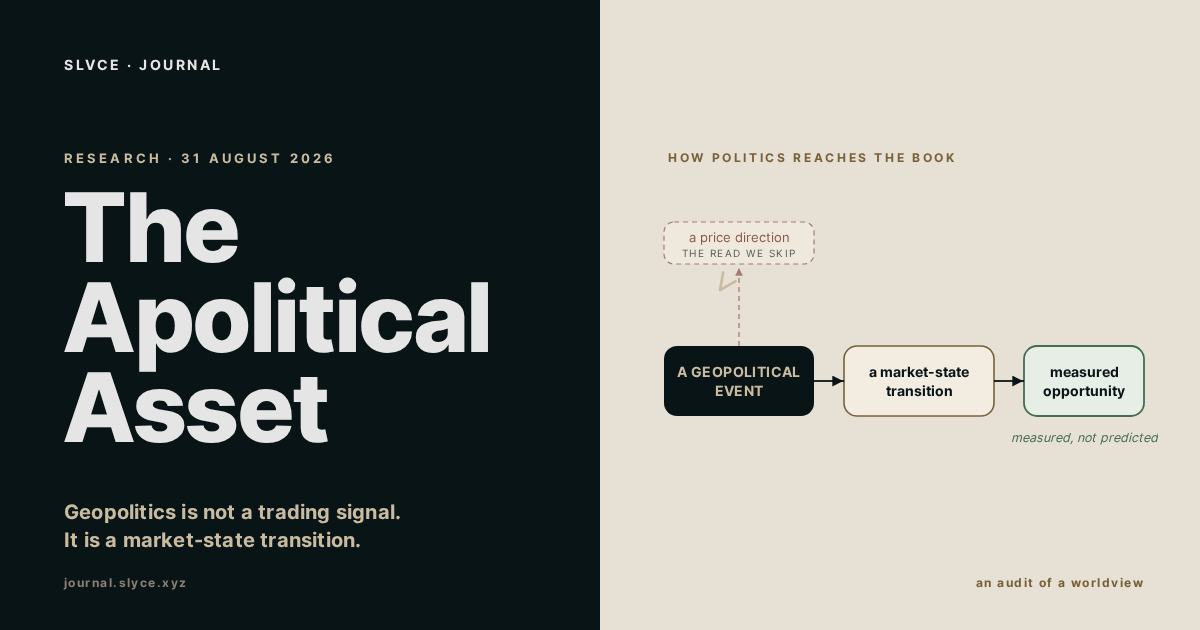
This is the whole turn of the essay, so it is worth drawing.
Politics does not hand you the direction of crypto. What it reliably delivers is a change in the market's state - its depth, its spreads, its volatility, its toxicity, the access rules of its venues, the degree to which venues briefly disagree with one another about the price of the same asset. A sanctions headline does not tell you whether to be long or short. It tells you the probability of a market-state transition has just risen sharply - and whether that transition means thinner depth, wider spreads, more fragmentation or simply more flow is something to measure, not assume. That is not a price forecast. It is a statement about microstructure - and microstructure is measurable in a way that geopolitics is not.
This matters because a book that earns from activity rather than direction lives or dies on exactly those state variables. Its return comes from spread, from flow, from the constant small mispricings between venues - and those are functions of market structure, not of who wins an election. So the honest translation of a geopolitical shock, for such a book, is not "opportunity" or "danger." It is: the opportunity set has changed; go measure it.
And here we have to resist our own best line, because the tempting version of this argument is false and contradicts our own writing. It would be easy to say that the frightening weeks are the profitable ones - that disorder is simply raw material. It is not. Disorder is not automatically profitable.
For a market-neutral book, geopolitical disorder is not a directional signal. It is a change in the opportunity set - sometimes richer, sometimes more toxic, always something to measure rather than assume.
Sometimes a shock deepens the pool of mispricings and pays well. Sometimes the same shock does the opposite: it withdraws depth, widens the basis, raises adverse selection, and makes neutral execution worse, not better. The order book that looked two feet deep at noon is gone by the time the news lands -
- and a strategy that assumed that depth would hold discovers, in exactly the loud week it expected to harvest, that the raw material has turned toxic. We wrote a whole post-mortem, Red Days, about a stretch where a violent-but-rising tape did precisely this to the inventory leg of the book: the week that looked full of opportunity was the week the losses came from. And we have argued at length that liquidity is a loan - that displayed depth is a standing offer from professionals whose survival depends on withdrawing it at the worst possible moment for you. A geopolitical shock is one of the most reliable triggers of exactly that withdrawal.
So the transmission is not the naive chain politics → volatility → profit. It is longer and more honest:
politics → a change in market structure → shifts in depth, spread, volatility, toxicity and venue access → an opportunity set that must be measured, not predicted.
This is where the discipline stops being a slogan and becomes an instrument. Continuously measuring that state - how deep, how toxic, how fragmented the market is right now - is what a liquidity-weather read is. It does not tell us where SOL is going. It tells us what kind of market we are standing in, so that risk is throttled up when the state is benign and down when it turns adverse - regardless of what the headline "means" for price. The news never enters as a view. It enters as a change in the readings.
Two investors, one event
Put two investors in front of the identical headline and watch their questions diverge.
The directional one asks which way. Their whole year becomes the batting average of their reads against a world that specialises in not being read - and in the good years they look like geniuses, while in the bad ones they discover their "strategy" was a position all along, quietly correlated to the very risk they thought they were merely expressing a view on. The market-neutral one asks what state: did depth thin, did spreads widen, did the venues start disagreeing, did toxicity rise past the point where quoting is a donation? Their worst outcome is not "the world went the other way." It is "we misread the state" - a measurement problem, and therefore fixable, in a way a wrong macro guess never is.
We drew the same line last week in a much smaller key: SOL rose, the strategy lost money, the account went up anyway, and the whole point was telling the market's contribution apart from ours. Geopolitics is only the loud version of that rule. Two nearby pieces sit directly under it - volatility is not risk, and BTC and ETH are not diversification, because in exactly the shocks that matter most the correlations converge toward one, and the portfolio that felt diversified in calm markets turns out to be a single macro bet at the precise moment diversification was supposed to help. What you think you own in a crisis is often not what you own.
The operating conclusion
Put the argument end to end and it collapses into something usable.
Crypto's political innocence was always temporary, and it is over. Pretending otherwise is nostalgia, and nostalgia is not a strategy. But the more expensive mistake is the opposite one - taking the new political sensitivity as a thing you can forecast and trade, and dressing the resulting directional bet in the language of analysis. The reversal is real; the trade it seems to imply is a mirage.
The operating doctrine that survives all of this is short. When the world moves, we do not ask it where it is going. We ask it what it just did to the market we work in - and then we measure that, throttle to it, and keep earning from activity we did not have to predict. Every geopolitical event is, for us, an input to one system: the read on the state of the market. It is never a position.
Which is the sentence the whole essay exists to earn:
Geopolitics is not a trading signal. It is a market-state transition.
The line to keep
The apolitical asset is gone. What replaces it, for a serious allocator, is not a better crystal ball and not a bolder macro thesis. It is the humility to earn from the disorder that politics creates - while measuring, every hour, whether that disorder is a richer opportunity or a more toxic one - without ever pretending to know what the politics will do next.
The moment an asset becomes political is the moment betting on its direction becomes a bet on statecraft - the rarest and least repeatable edge in finance. The durable edge is in building a system that does not need the call.
Research pieces argue a thesis about how investing works, not about what the market will do tomorrow. The mechanics under this one live in Why Volatility Is Not Risk, Liquidity Is a Loan and Where Return Actually Comes From.
Further reading, outside our walls. For the serious institutional work on how crypto and sovereign power now intersect: the Bank for International Settlements on stablecoins and central-bank digital money; the International Monetary Fund on crypto assets and capital-flow management; the Financial Stability Board on stablecoin regulation; the Atlantic Council's CBDC tracker for the sovereign-money map; and Chainalysis on how transparent that "anonymous" ledger really is. We do not endorse every conclusion in them. We read all of them.